There is a moment every wreath maker knows. The design looked perfect on the table. You hang it on the door, step back, and something has shifted. The bow is lower than you tied it. A stem that sat proud now droops. The whole thing leans slightly to one side, and you cannot say why.
The reason is simple: you built it flat and it lives vertical. Gravity was not in the room when you designed it. It is in the room now.
What happens when a wreath goes vertical
Every element on a wreath is attached at a point and has weight beyond that point. On a table, that weight rests on the surface and everything stays where you put it. On a door, that weight pulls down. Ribbon tails swing. Long stems tip. Anything attached with a single wire pivots around it. A focal piece that was balanced by a cluster of florals opposite it now has gravity on its side, and the balance you worked so hard on is gone.
The effect is small on each piece and large on the whole. A dozen elements each sagging a little adds up to a wreath that reads as tired.
The fix is to build it standing up
Professional designers do not build on a table. They build on a stand that holds the base at the angle the finished wreath will hang at, so gravity is part of the design from the first stem. When something droops, you see it immediately and fix the attachment. When the balance tips, you see it and add weight to the other side. Nothing is a surprise on the door because the door and the bench were the same angle.
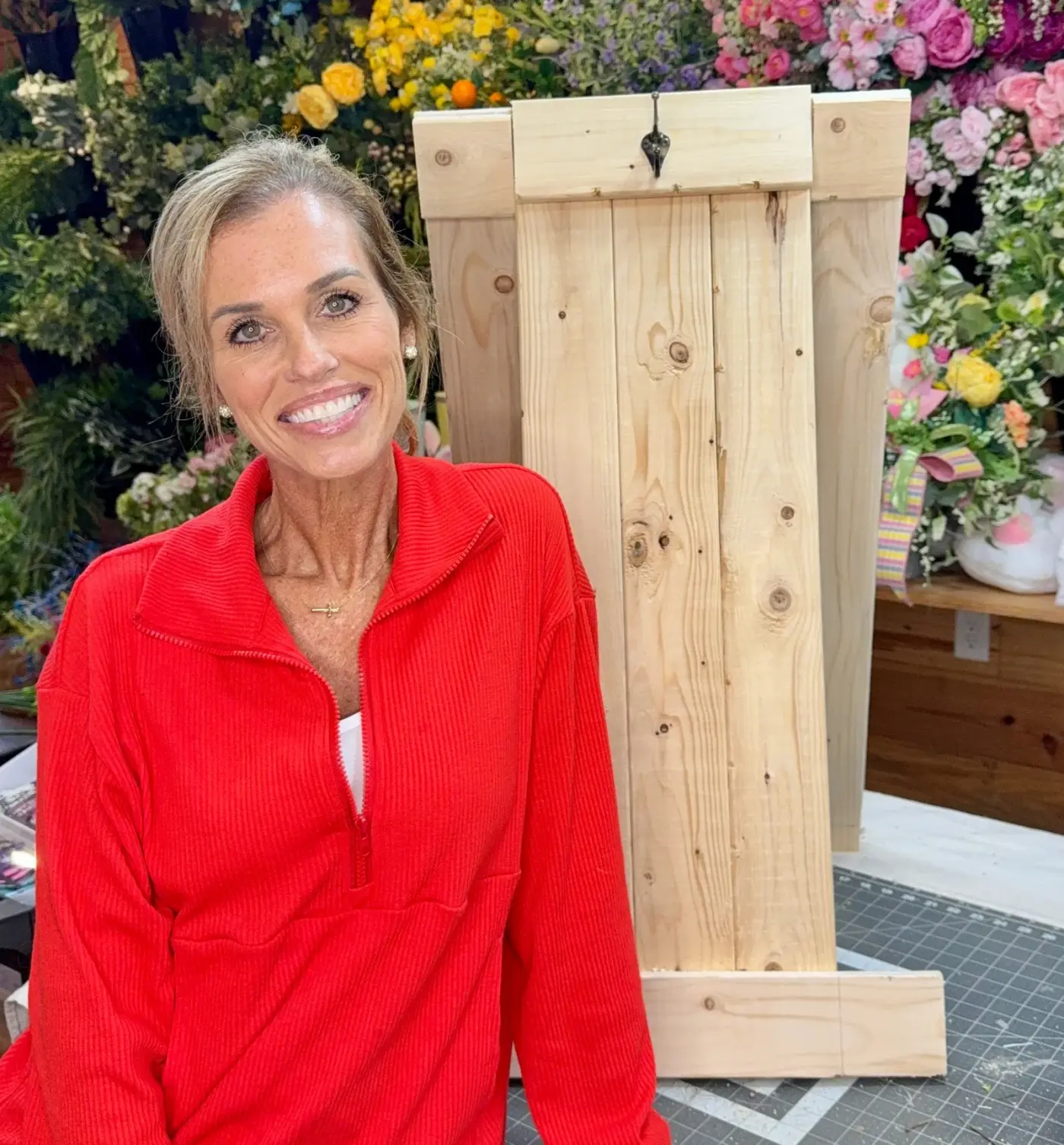
That is what the Wreath Making Easel is for. Kandi designed it after years of building wreaths by hand in her Savannah workshop and being frustrated with everything else she tried. It is a solid wood, foldable easel that measures 37 inches tall by 17 inches wide, with a hook at the top that grips a standard grapevine or deco mesh base and a wide lower brace that keeps even an XL design steady while you work. It is patent pending.
What it changes about the work itself
Building upright changes more than the result. It changes the three hours you spend making it.
- Your back. Hunching over a dining table for a whole design is the real reason the end of a wreath gets rushed. An easel puts the work at standing or seated height.
- Your view. On a table you look down at a wreath. On an easel you look at it the way a visitor at your door will, so you catch the gap on the lower left that you would never have seen from above.
- Your photos. If you sell your work, the listing photo is the product. A wreath on an easel photographs like a wreath on a door. A wreath propped against a wall photographs like a wreath propped against a wall. There is more on that in photographing wreaths for your listings.
It folds flat
The reason most makers do not own a stand is space. Kandi's easel folds flat and stores against a wall between projects instead of owning a corner of the room. That was a design requirement, not an afterthought, because her own workshop has to hold supplies for every season at once.
Who it is for
Anyone who builds more than one wreath a year. The easel is the only tool in the workshop that touches every single design you will ever make, which is why it is the one Kandi built herself rather than settling for what was available. It ships from the Savannah workshop, and unlike the wreaths, it is repeatable stock: when a batch sells through, the next batch is the same easel.
It is also the tool the Krew instructors work on during live sessions, so if you learn inside the Kreative Krew you will see it in use every week.
If you are not ready for a stand yet
You can improvise. Lean the base against something at roughly a door's angle and work on it standing. It is awkward, it will fall over, and you will end up wanting the real thing, but it is enough to prove the point: build one wreath vertical and you will never build flat again. The free Intro to Wreath Making course covers the structure of a balanced wreath, which is the other half of this problem, and why your wreath looks off goes deeper into balance.
Frequently asked questions
Will an XL wreath fit on the easel?
Yes. The hook holds standard grapevine and deco mesh bases and the wide lower brace is there specifically so larger designs stay put.
Is it a working easel or a display stand?
Both, but it is a working easel first. It holds the base at working height and at hanging angle while you build, and then doubles as a display and photography stand for the finished piece.
Does it come assembled?
It is a foldable solid wood easel. It arrives ready to unfold and use, and folds flat again for storage.
Where does it ship from?
Kandi's workshop in Savannah, Georgia, with checkout on her own store. Details are on the easel page.